
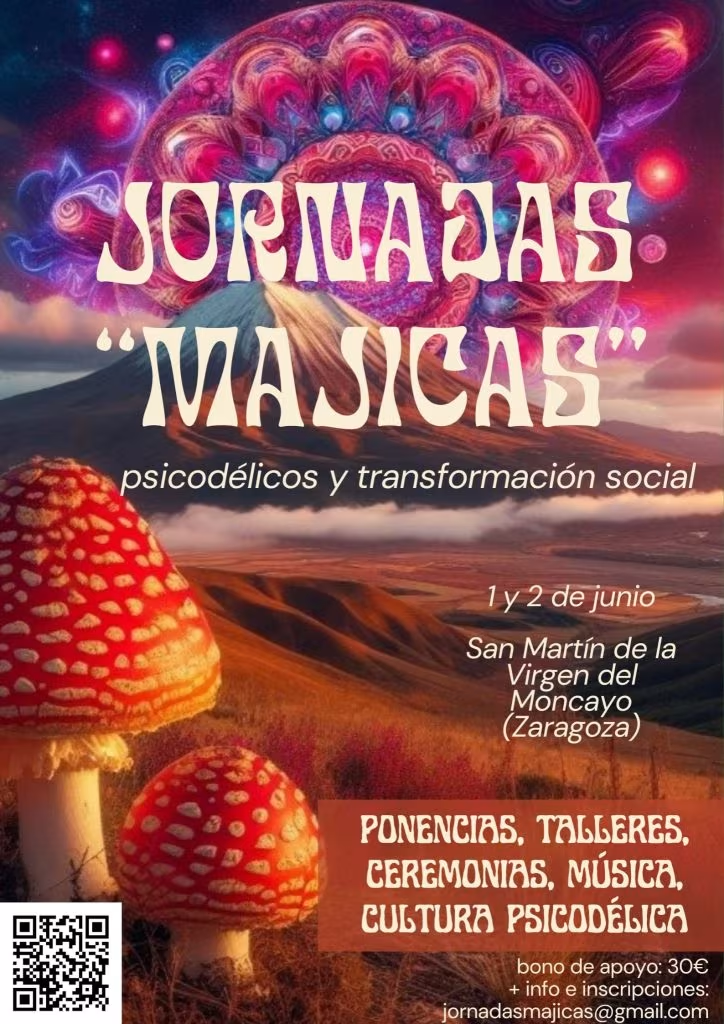
On the slopes of the mystical Moncayo, a natural area of Aragón with a long history tied to legend and spirituality, a singular gathering took place on the first weekend of June last year. On the 1st and 2nd, the small town of San Martín de la Virgen del Moncayo, in Zaragoza, became the epicentre of the “Májicas” Conference. The name itself, with its playful twist on spelling, already suggested a light-hearted and perhaps transgressive approach to a fascinating and complex subject: “psychedelics and social transformation”. At a time of growing global interest in the therapeutic and consciousness-expanding potential of these substances, the conference offered a space for collective exploration, open dialogue and shared experience.
Echoes of the previous edition: a mosaic of knowledge and experiences
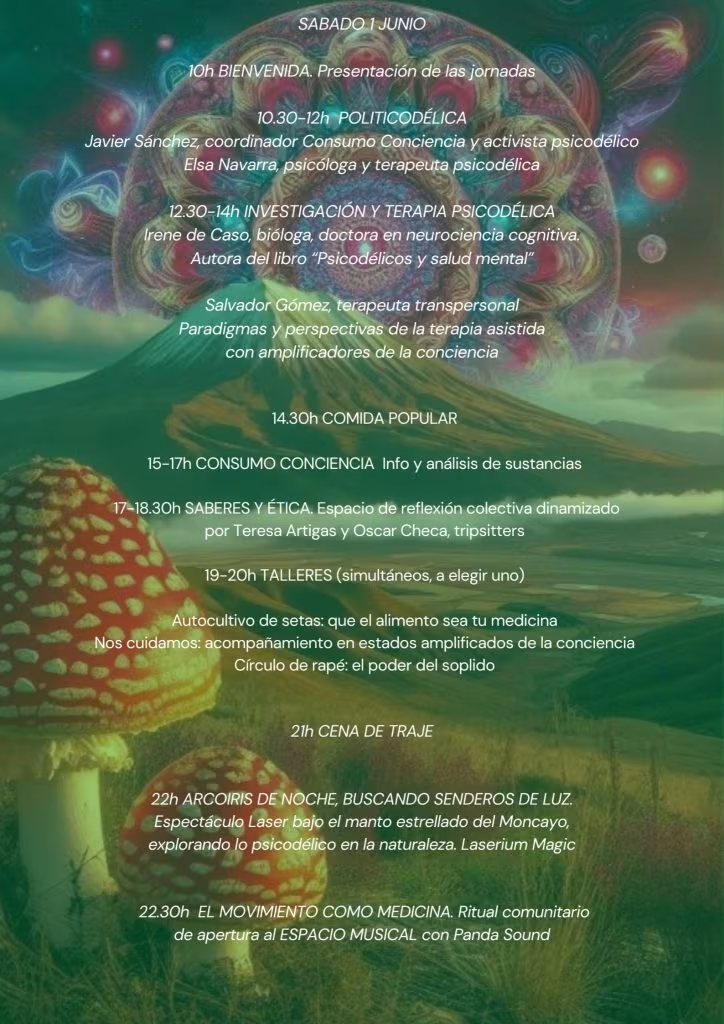
The promotional posters from the last edition let us reconstruct the vibrant mosaic of activities that made up the event, designed to nourish mind, spirit and body alike. Far from being a mere academic symposium, the event was shaping up as a full immersion in psychedelic culture and its possible implications for individual and collective change.
1. Nourishing the intellect: talks and workshops
Although the specific speakers and topics do not appear on the available posters, the explicit mention of “Talks” and “Workshops” is fundamental. We can imagine a varied programme in which experts, researchers, therapists, artists and activists shared their knowledge and experience. The topics covered probably spanned a wide range: from the neuroscience of psychedelics and the latest advances in therapeutic research (for depression, PTSD, addictions), to the rich history of entheogen use in various ancestral cultures and its role in rituals and worldviews.
Other possible focuses of discussion might have been the legal and ethical frameworks around these substances, the philosophies of consciousness that inspire or derive from these experiences, and methodologies for the psychological and life integration of psychedelic experiences. The workshops, for their part, would surely have offered more practical, interactive spaces: perhaps introductions to meditation or mindfulness techniques relevant to preparation or integration, workshops on artistic expression inspired by non-ordinary states of consciousness, or discussion groups on harm reduction and safe practices.
2. Connecting with the heart and spirit: ceremonies
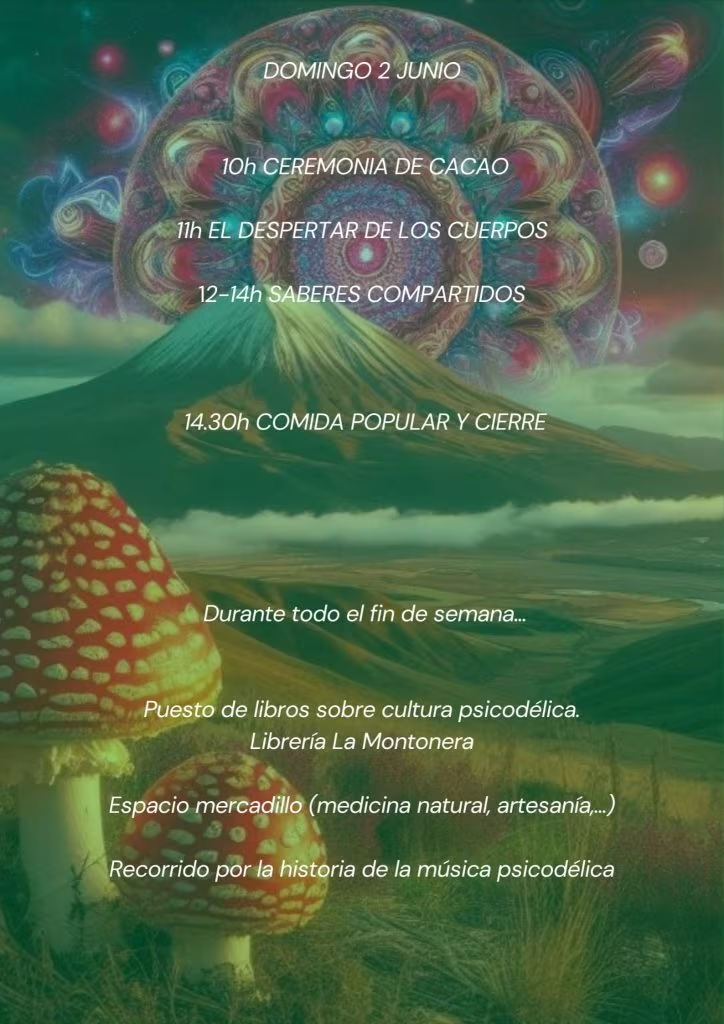
The Sunday programme reveals a central activity at 10 am: a Cacao Ceremony. Ceremonial cacao, prepared in a specific way and consumed in a ritualised context, has become popular in wellness and alternative spirituality circles for its ability to foster emotional openness, group connection and a feeling of wellbeing and warmth. Although it is not a psychedelic in the strict sense (it does not produce the perceptual alterations of substances such as psilocybin or LSD), it is considered a “psycho-affective” or “heart opener”.
The inclusion of this ceremony suggests an orientation of the conference towards the emotional and spiritual dimension, recognising the importance of ritual and intention (“set and setting”) when working with expanded states of consciousness, even the subtlest ones. It is plausible that, beyond cacao, the term “Ceremonies” on the general poster referred to other guided practices, perhaps deep meditations, rituals of connection with the surrounding nature of Moncayo, or ceremonies of intention and closing.
3. Inhabiting the body: the awakening of bodies
At 11 am on Sunday, the offering was “The awakening of bodies”. This activity points directly to the somatic dimension, so often forgotten in purely intellectual approaches. In the context of personal transformation and the integration of deep experiences, the body plays a crucial role. We can imagine a session combining mindful movement, free dance, breathwork, gentle yoga or bioenergetic techniques. The aim would be to release tension, increase body awareness, enable non-verbal expression and help anchor the insights or emotions that arose during the weekend. Reconnecting with the body is fundamental to integrating any process of change, and its inclusion in the programme underlines a holistic view of transformation.
4. Weaving networks: shared knowledge and community
The “Shared Knowledge” space, scheduled for Sunday midday (12–2 pm), represents an important pillar of the philosophy of events like this. It suggests a horizontal format, away from the expert–audience hierarchy, where all participants could contribute their knowledge, personal experiences, questions and concerns in an atmosphere of listening and mutual respect. Talking circles, open debates or simply facilitated informal conversation spaces may have been organised. This kind of dynamic fosters collective intelligence, validates personal experience as a source of knowledge and strengthens community bonds, key elements when addressing “social transformation”.
The community dimension was reinforced by other elements present throughout the weekend:
- Shared meal and close: Ending the event on Sunday at 2:30 pm with a shared meal is no minor detail. Eating together is a fundamental act of socialising and celebration in every culture. It offered an opportunity for relaxation, informal integration of what had been lived and strengthening the relationships formed before saying goodbye.
- Market area: The presence of a market with “natural medicine, crafts, etc.” connected the conference with a wider ecosystem of alternative culture, local economy and sustainable practices. It let attendees discover products aligned with a more conscious philosophy of life and supported small producers and craftspeople.
- Book stall (La Montonera bookshop): The collaboration with a local bookshop to offer literature on psychedelic culture is significant. Books are essential tools for deepening, contextualising and preserving knowledge in this field. The stall made it easier to reach rigorous information and diverse perspectives, from scientific studies to ethnographic accounts or philosophical essays.
5. The soundscape: psychedelic music
Music is an inseparable companion of psychedelic history. The announcement of a “Journey through the history of psychedelic music” suggests that there was not only ambient music but also a curatorial effort to explore the vast and rich relationship between sound and altered states. Perhaps through commented listening sessions, themed DJ sets or even live music, they explored the genres born of or transformed by psychedelic influence: 1960s acid rock, space rock, ambient, electronic music (psytrance, psychill), and the world music used in ceremonial contexts. Music not only sets the scene but can guide, deepen and shape inner experiences, as well as being a powerful vehicle for cultural identity and group cohesion.
Final reflections and looking ahead
The “Májicas” Conference of last year in Moncayo emerges, through the fragmentary information on its posters, as a rich, multifaceted and deeply intentional event. It sought to build bridges between intellectual knowledge, felt experience, community connection and cultural expression, all under the umbrella of psychedelic exploration and its transformative potential. The choice of Moncayo as the setting adds a layer of meaning, linking these contemporary explorations with a place of ancestral power and mystery.
The focus on “social transformation” invites reflection: how can experiences that are often considered intimately personal catalyse change in society? Perhaps by fostering empathy, dissolving mental rigidities, inspiring new forms of community organisation, a closer connection with nature, or questioning dominant cultural paradigms.
A recurring event
The posters are an echo of the previous edition. The conference is understood as a recurring event. The best way, and the only sure one, to find out the dates of the next edition is to contact the organisers directly at the email address provided: jornadasmajicas@gmail.com. Each new call may bring new approaches, speakers and proposals, keeping alive the crucial dialogue on psychedelics, consciousness and human potential for transformation in a privileged natural setting like Moncayo. The interested community, no doubt, remains attentive.